Español
 Français
 中文简体
中文简体

Product Consultation
Your email address will not be published. Required fields are marked *
Content
Kitchen cleaning wipes have become a staple in households worldwide — grab one, swipe a surface, toss it. The convenience is undeniable. But convenience and effectiveness are not the same thing, and a growing number of home cooks, food safety professionals, and hygiene-conscious consumers are asking harder questions about what kitchen cleaning wipes actually accomplish. Do they disinfect, or just move bacteria around? Are they safe on food-contact surfaces? Are antibacterial wipes meaningfully different from regular ones? And are there surfaces in your kitchen where you should never use them? This article answers all of those questions with the practical specificity that product packaging rarely provides.
One of the most important distinctions to understand before evaluating any kitchen cleaning wipe is the difference between cleaning, sanitizing, and disinfecting — three terms that are used interchangeably in marketing but have distinct, regulated meanings in food safety and public health contexts.
Cleaning removes visible dirt, grease, food residue, and debris from a surface. A cleaning wipe — whether it contains soap, a surfactant blend, or a mild solvent — physically lifts and traps these materials in its substrate, removing them from the surface when the wipe is discarded. Cleaning does not kill microorganisms; it reduces their number by removing the physical matrix they live in. Sanitizing reduces the number of microorganisms on a food-contact surface to levels considered safe under public health standards — typically a 99.9% reduction (3-log reduction) of specific bacteria. Disinfecting goes further, killing 99.999% (5-log reduction) of bacteria and, in some formulations, targeting viruses and fungi as well. Disinfecting wipes that carry EPA registration numbers in the United States, or equivalent regulatory approvals in other markets, have been laboratory-tested to prove these kill claims against specific organisms on specific surface types.
The practical implication is straightforward: if you are wiping down a cutting board after raw chicken preparation, a cleaning wipe is insufficient — you need a sanitizing or disinfecting product. If you are simply removing coffee splatter from your countertop between meals, a cleaning wipe is perfectly adequate. Matching the wipe type to the actual hygiene requirement is the foundation of using kitchen cleaning wipes effectively.
The active ingredient in a kitchen cleaning wipe determines what it can and cannot do, which surfaces it is safe for, and whether it poses any risk to food safety when used near food preparation areas. Understanding the chemistry helps you make better purchasing and usage decisions.
| Active Ingredient | Common Use | Effective Against | Key Limitations |
| Quaternary Ammonium (Quats) | Disinfecting wipes | Bacteria, some viruses, fungi | Requires dwell time; deactivated by organic matter |
| Isopropyl / Ethyl Alcohol | Antibacterial wipes | Bacteria, enveloped viruses | Evaporates fast; poor on soiled surfaces; flammable |
| Hydrogen Peroxide | Disinfecting wipes | Bacteria, viruses, spores | Can bleach some surfaces; degrades with light |
| Sodium Hypochlorite (Bleach) | Heavy-duty disinfecting | Broad-spectrum bacteria, viruses, fungi | Corrosive to metals; discolors surfaces; strong odor |
| Surfactant / Soap-Based | Cleaning wipes only | Grease, food residue, loose debris | No antimicrobial kill claims |
The single most important — and most consistently ignored — aspect of using disinfecting kitchen wipes is dwell time. Dwell time is the period the surface must remain visibly wet with the wipe's active solution for the kill claims on the label to be achieved. For quaternary ammonium-based disinfecting wipes, this is typically between two and four minutes. For hydrogen peroxide formulations, it may be as short as 30 seconds but still requires the surface to stay wet throughout. Most people wipe a surface and consider it clean the moment the visible moisture disappears — which often happens in under 30 seconds on a warm countertop — meaning the disinfection is incomplete regardless of how effective the chemistry would be under correct conditions. Reading the dwell time on the product label and genuinely waiting for that period before assuming a surface is disinfected is the single behavioral change that most improves the real-world effectiveness of kitchen disinfecting wipes.
Not all kitchen surfaces respond well to all wipe formulations. Using the wrong wipe on the wrong surface can cause cosmetic damage, accelerate material degradation, or leave chemical residues that are unsafe near food. The following breakdown covers the most common kitchen surfaces and how to approach each correctly.
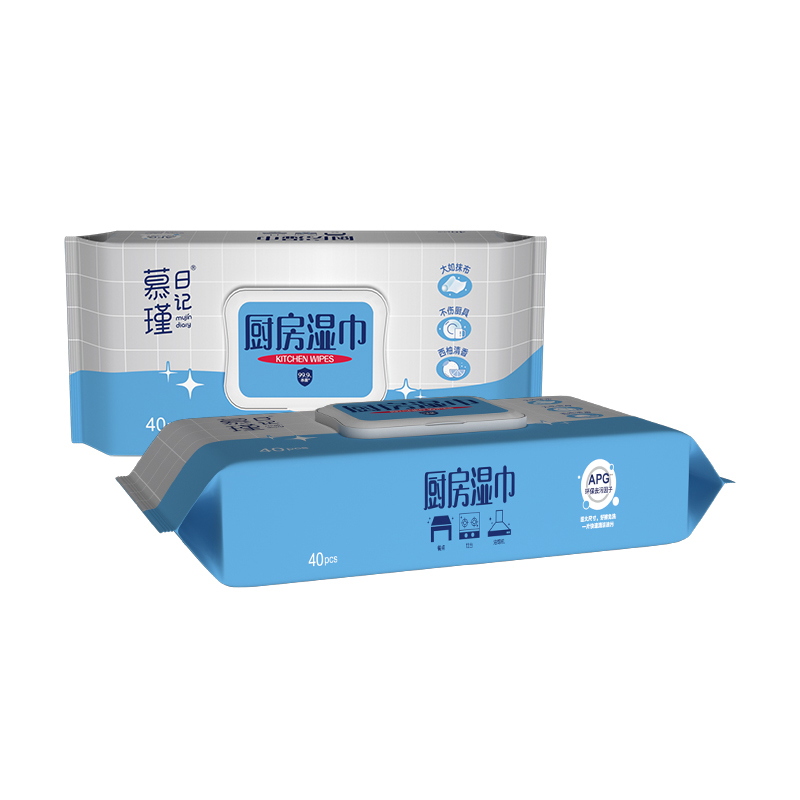
Kitchen cleaning wipes introduce chemical residues onto surfaces that may come into direct contact with food. While most consumer disinfecting wipes are formulated to be safe at the concentrations present on a wiped surface after the solution dries, food safety best practices still apply — particularly when wiping surfaces that will immediately be used for food preparation.
The standard food safety recommendation for any chemical sanitizer or disinfectant applied to food-contact surfaces is to rinse with potable water after the dwell time if the surface will have direct food contact within a short period. Quaternary ammonium compounds, while effective disinfectants, are not considered food-safe at the concentrations present on a freshly wiped surface and should be rinsed off food-contact zones before placing unwrapped food directly on them. Hydrogen peroxide-based wipes break down into water and oxygen as they dry, presenting a lower residue risk — but rinsing is still the safest practice before direct food contact. Alcohol-based wipes evaporate completely as they dry, leaving no chemical residue, which is why they are often preferred in commercial food preparation environments for quick between-task surface sanitizing.
Using kitchen cleaning wipes incorrectly can spread contamination rather than eliminate it — a risk that undermines the entire purpose of the product. The following practices ensure that wipes perform as intended rather than redistributing bacteria across kitchen surfaces.
With dozens of wipe products marketed for kitchen use, matching the right product type to your household's actual needs avoids both overspending on unnecessary disinfecting capability and underspending in situations where genuine pathogen elimination is required.
| Household Situation | Recommended Wipe Type | Key Requirement |
| Daily countertop maintenance | Surfactant-based cleaning wipe | Grease and food residue removal |
| After handling raw meat or poultry | EPA-registered disinfecting wipe (quat or H₂O₂) | Full dwell time; pre-clean surface first |
| Household with young children or elderly | Food-safe disinfecting wipe; rinse after use | Verified food-contact safety; no strong fragrances |
| Stainless steel appliance care | Stainless-safe cleaning wipe; no bleach | Streak-free finish; corrosion prevention |
| Illness in household (norovirus, flu) | EPA-registered disinfecting wipe with virus claims | Verified virus kill claims; strict dwell time compliance |
| Eco-conscious household | Plant-based or biodegradable cleaning wipe | Compostable substrate; biodegradable actives |
Single-use kitchen cleaning wipes generate significant non-biodegradable waste, particularly those made from polyester or polypropylene nonwoven substrates — materials that persist in landfill for decades. For households concerned about environmental impact, several approaches reduce waste without sacrificing hygiene performance.
Kitchen cleaning wipes are genuinely useful tools when matched to the right tasks, used with the right technique, and selected with an understanding of what their chemistry can and cannot do. The gap between a wipe that merely smears contamination around and one that genuinely reduces pathogen risk on your kitchen surfaces is not primarily about which brand you buy — it is about understanding dwell time, surface compatibility, the clean-before-disinfect principle, and the one-wipe-one-surface discipline that separates hygiene theater from actual food safety practice.
Your email address will not be published. Required fields are marked *
You can contact to me using this form.


Copyright © 2023 Shanghai Taicikang Industrial Co., Ltd. All Rights Reserved.
 OEM/ODM Wet Wipes Manufacturers
BACK TOP
OEM/ODM Wet Wipes Manufacturers
BACK TOP